Depleted Food Banks and Food Insecurity
Why food insecurity is growing in Georgia's District 1 and Savannah, and what we can do despite the government drastically reducing federal aid.
Summary
The United States is entering a perfect storm where food insecurity will become an increasingly important issue. Food prices are increasing, the economy is shaky, and food insecurity is rising across the United States, including Georgia. With the Trump administration cutting back aid, food banks and mutual aid are one of the last guardrails against outright large-scale starvation.
Last Update: Jul 29, 2025
Actions You Can Take
Donate food, money, or time to food banks and mutual aid projects
At voting time, hold Buddy Carter and the GOP accountable for their votes to reduce aid going to families, hospitals, and farms
Fast Facts
- Single parents are the most affected by food insecurity – moms and dads – and Black and Hispanic households also trend above the national average.
- Food insecurity in Georgia’s First Congressional District trends higher than the national level.
- The cost of food is becoming a higher percentage of household expenses.
- In Georgia, 12.7% of the population (1.4m people) are enrolled in SNAP.
- As of March 2025, the USDA is cutting $1B in funding to programs that supply food to food banks.
- As of July 2025, Republicans approved a spending bill that will gut Medicaid benefits in 2026 and 2028 (conveniently going into effect immediately after national elections).
- Because of these cuts to federal programs, rising food costs, and economic distress in poverty-level families, food banks in Georgia’s District 1 are routinely depleted.
What is “Food Insecurity”?
The term “food insecurity” (and its counterpart, “food security”) are terms defined by the USDA to measure the “availability of nutritionally adequate and safe foods” within the framework of measurable economic conditions. The USDA no longer measures hunger, which they define as an “individual-level physiological condition that may result from food insecurity”.
Food Insecurity in the U.S., Georgia, District 1, and Chatham County
Food insecurity is going up a national level, centered in rural and southern counties. Nearly 39% of households with incomes below the Federal poverty line were food insecure. Single parents are the most affected – moms and dads – and Black and Hispanic households also trend above the national average.
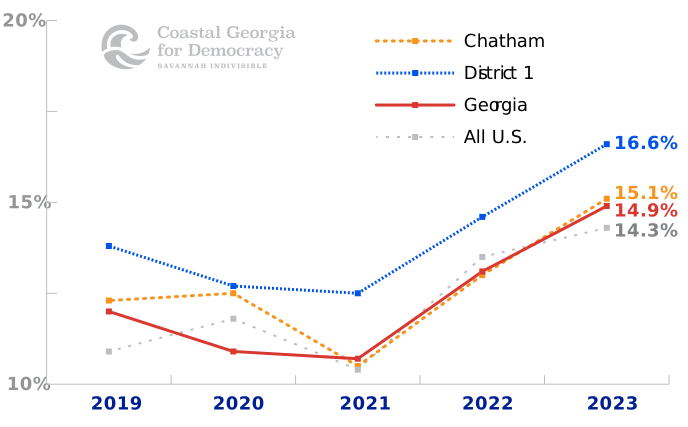
Food insecurity is growing in all areas. Georgia as a whole and Chatham County are largely in line with national averages, but District 1, encompassing many rural counties in Southeast Georgia, consistently trends higher. 2023 is the most recent data available. (Source)
Why is Food Insecurity Rising?
Food insecurity is increasing because the cost of food is rising, SNAP does not reach everyone in need, and government funding has been significantly cut.
The Cost of Food
In the past four years, the rising price of food has outpaced inflation. From February 2020 to July 2025, grocery prices grew a cumulative 25.6%. (Inflation was 21.6%.) This is not necessarily because of simple “greedflation” as the Biden administration often claimed, but a host of interrelated factors, including fuel costs, avian influenza, the Russian invasion of Ukraine, and more. But that doesn’t change the reality. Food is simply more expensive. Anyone that regularly shops for groceries does not need this explained.
The cost of food is also becoming a higher percentage of household expenses – especially for low-income households. Households in the bottom 20% of income spent an average of 32.6% of after-tax income on food. Households in higher income spent more on food, but less as a percentage of income. As budgets are stretched thin, food insecurity grows.
This is compounded by stagnant wages in the lower end of the working economy. Federal minimum wage has remained unchanged at $7.25 since 2009 and 30 states, including Georgia, maintain this figure as the minimum wage.
SNAP Leaves Many Behind
The Supplemental Nutrition Assistance Program (SNAP) is a crucial federal program to help those in need. But its effectiveness is often in the hands of the states, who have control over how the program is administered. This, plus its intrinsic barriers of entry, create a benefit that is unevenly applied. For example:
- Undocumented immigrants are prohibited. This creates problems for mixed-status families.
- Financial eligibility is narrow. It changes based on household size, but for non-seniors, applicants must be below 130% of the federal poverty level (totaling $3,250 gross income per month). For a family of four in Georgia, this equates to $39,000 in annual income before taxes.
- Georgia has the slowest approval time of any state, far past the rules set at the federal level, because of its mandatory work requirements.
This problem will only get worse as GOP-led states refused Medicaid expansion as part of the “Medical Unwinding”.
In Georgia, 12.7% of the population (1.4m people) are enrolled in SNAP. District 1 will lose $2 billion in funding for Georgia Medicaid and PeachCare for Kids (Georgia’s CHIP program), affecting 162,000 people.
The Federal Government is Cutting Aid
- Federal spending on food support declined well before the second Trump administration. The USDA’s food and nutrition assistance programs totaled $166.4 billion in fiscal year 2023, 13% less than fiscal year 2022, adjusted for inflation. Inflation-adjusted spending on SNAP, the largest USDA nutrition assistance program, was nine percent lower than the previous year.
- As of March 2025, the USDA is cutting $1B in funding to programs that supply food to food banks. Both the The Emergency Food Assistance Program (TEFAP) and the Local Food Purchase Assistance Program saw $500m budget reductions. Importantly, these cuts don’t just hurt those suffering from hunger. They also hurt farmers and producers that sold significant amounts of food to the government to supply these programs. Georgia, whose economy centers on agriculture and whose rural schools are chronically underfunded, will be hit very hard.
- As of March 2025, the Local Foods for Schools program was canceled.
- As of March 2025, USDA stopped all Patrick Leahy Farm to School grants. This program supported efforts nationwide to introduce students to locally grown produce and increase consumption of healthy foods.
- The “big beautiful bill” that passed the House in July 2025 will cut $1 trillion from Medicaid and SNAP in order to pay for tax cuts for the rich, with the biggest cuts delayed until 2026 and 2028 to coincide with election cycles. About 40% of SNAP beneficiaries are children and many adults will not qualify for the new stricter work requirements, including seniors, veterans, the disabled, and other vulnerable populations. SNAP, which already leaves many in need, will become even less effective in preventing food insecurity and economic distress. Buddy Carter, Georgia First Congressional District’s Trump sycophant representative, is “very proud” to have signed this bill that will hurt thousands of families in his district.
What About Food Banks and Mutual Aid?
Because of these cuts to federal programs, the rising costs of food, and economic distress in poverty-level families, food banks in District 1 of Georgia are routinely depleted. This is where we can help.
Coastal Georgia, Congressional District 1
Second Harvest of Coastal Georgia covers all of coastal Georgia and Congressional District 1, with hundreds of donation centers and food sites from Savannah to St Marys.
Food Banks in Savannah
- Episcopal Church of the Epiphany, located at 3101 Waters Drive (at Washington Ave.) provides groceries to families every Tuesday morning.
- Thomas Park Food Pantry, sponsored by The Episcopal Church of St. Paul the Apostle at 1802 Abercorn Street, distributes food every second and fourth Tuesday of the month.
- Savannah DSA hosts a Mutual Aid Sharing every Saturday at 37th and Waters between 3 p.m. and 5 p.m. (summer hours).
- Food Not Bombs in Savannah provides hot meals on Saturday and Sunday, from noon to 4 p.m., at West 38th Street, between MLK and Montgomery Street. Rain or shine.
- People Helping People of Savannah provides meals in Forsyth Park every Sunday at 12:45 p.m. across from Brighter Day Natural Foods Market at 1102 Bull Street. Rain or shine.
- Emmaus House is an unrestricted soup kitchen that serves breakfast Monday through Thursday.
What Should You Donate?
First of all, if donating food is not physically possible, please consider donating money. Food pantries and mutual aid projects are volunteer-driven, but food is not free. Giving money goes directly to supplying food for those in need.
If giving money is not possible, consider volunteering to pack food bags or organizing a food drive for Second Harvest of Coastal Georgia. Consider volunteering to cook food or help with mutual aid programs.
Recommended Food Items for Donations
- Canned proteins are most desirable. Canned tuna, salmon, chicken, etc.
- Peanut butter!
- Boxed milk is a treasure. Kids need it for cereal (which they get a lot of)
- Canned beans, vegetables, and soups are great, but when possible, please give cans with pull-tab tops that don’t need a can opener
- Vegetable or canola oil for cooking
- Tea bags and ground coffee
- Sugar and flour
- Pasta and canned sauces
- Crackers, cookies, cereal
- Cake mix and frosting helps for kids’ birthdays
- For dry boxed food, consider the ingredients necessary to make the meal. For example:
- Pancake mixes that just need water: easy kid-friendly breakfast
- Stove Top stuffing and Rice-a-Roni: easy out of the box
- Hamburger Helper: requires ground meat
- Mac and cheese: requires milk and butter
- Salt, pepper, spices, seasonings
- Can openers
- Dishwashing detergent and related supplies
- Feminine hygiene products are always welcome
All items should be new, unopened, and not expired.
How to Help With Voting
Vote local. This matters as much as (if not more than) federal elections when it comes to helping local communities help those in need. City and county commissioners, mayors, sheriffs, and comptrollers are all influential.